
We are happy to announce the release of IMPETUS Solver 10.1.0!
New features and improvements
Version 10.1.0 introduces several important bug fixes and some new features. For the complete list of updates, see the release notes for the Engine and the GUI. As always, the new version can be downloaded here.
Improvements to natural fragmentation modelling
The most important new feature in this release is related to natural fragmentation modeling, where Erode-to-SPH (E2S) can now replace node splitting in such applications. In this regard the E2S functionality has been extended and improved. A new command, *EROSION_CRITERION_SPH_DRIVEN has been added that allows the conversion from FE to SPH to be controlled by the SPH domain. The local dynamic refinement of going from one element to many particles gives more degrees of freedom for where the cracks will grow and propagate, giving more naturally shaped fragments that are not restricted to follow element lines. The new command ensures that the conversion is done before the cracks reach the elements. This is relevant not only for natural fragmentation of warheads, but also for crack propagation in ceramics, shaped charge jet interaction with targets and more.
For more details on the technique, numerical validation and demo model, have a look at this article in the knowledge base.
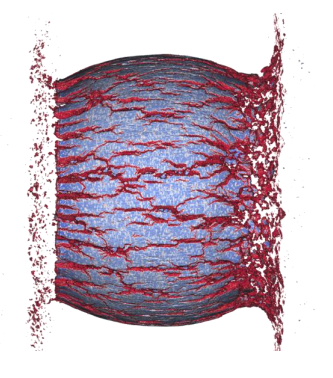
The new technique gives fragments consisting of a combination of finite elements and SPH particles. Unfortunately such hybrid fragments are not yet supported in the GUI. This means that the fragment distribution cannot yet be investigated in the fragmentation toolkit or in the V/L tool. This will be added in a future release.
Bug fixes
One of the critical bug that several users have reported was that some jobs could be stuck in Waiting state forever if they initially failed because not enough GPU memory was available. This bug has now been fixed and the functionality improved. If a relatively large job that by itself fits into the GPU memory fails with out-of-memory error because of other running jobs, that job will automatically be put back into waiting state and be run again when other jobs finish. However, jobs too big to fit into memory will fail one and not put back into the queue.
Version 10.0.1 introduced *CFD_BLAST_1D as a technology preview. A critical bug was found and fixed, so this featue should now be fully usable.