CFD_WIND_TUNNEL
CFD
Beta command
This command is in the beta stage and the format may change over time.
"Optional title"
fid${}_v$, fid${}_\rho$, fid${}_T$, $C_v$, $\gamma$, Pambient, gid
entype, enid, state
Parameter definition
Description
This command is used to convert the CFD domain into a virtual wind tunnel. Default ambient air conditions are assumed be at pressure $1 \mathrm{atm}$ and temperature $293 \mathrm{K}$. The flow inlet is at $x_0$ and the outlet is at $x_1$ (see CFD_DOMAIN).
Note that this command is only useful at supersonic speeds, as boundary layer and viscous drag effects are not accounted for.
An optional geometry can be specified to mark a region in space where the initial flow velocity is zero.
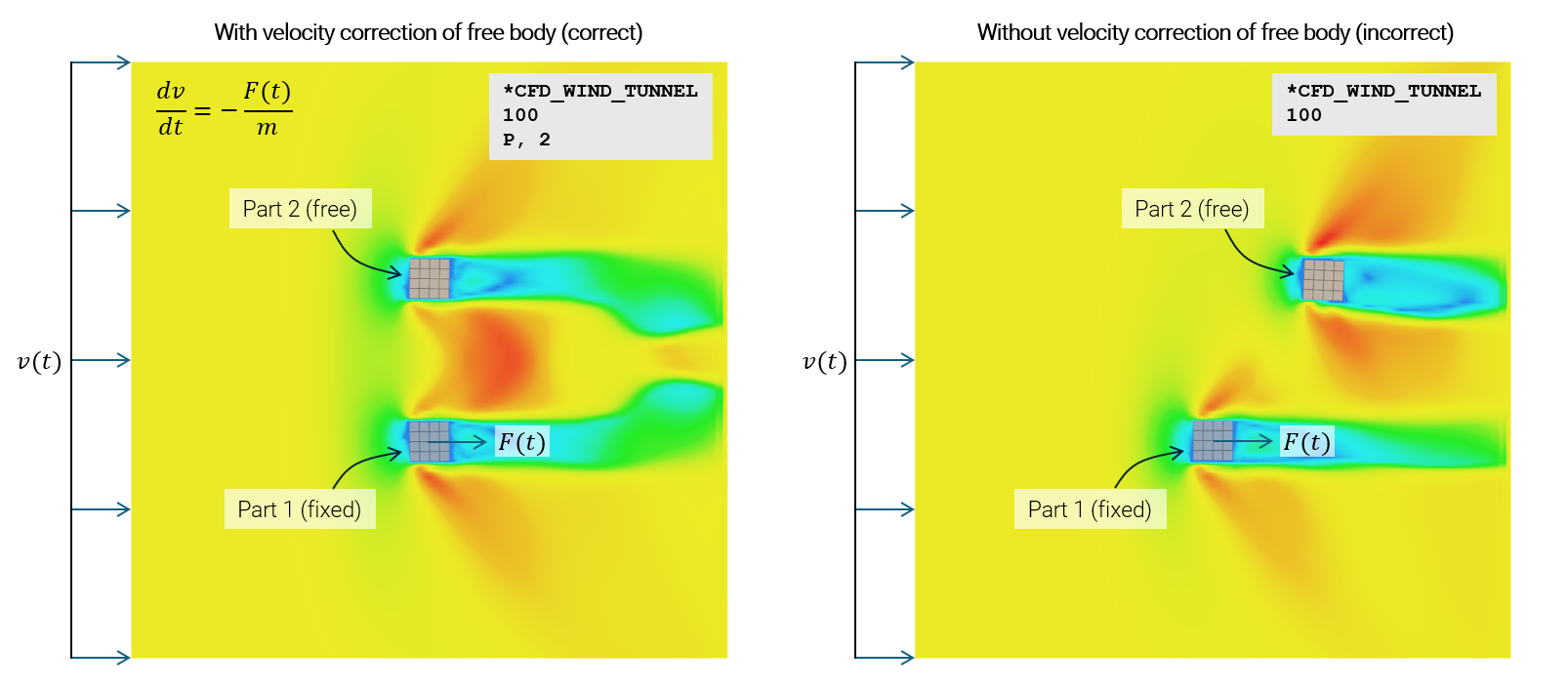
A common procedure is to constrain a reference FE object in the $x$-direction. A virtual deceleration is calculated from the measured drag forces and can be used in a feedback loop to update the inlet flow velocity. Free objects (entype, enid) are FE parts that are not constrained in the $x$-direction. Their velocities are corrected to account for this virtual deceleration. Examples are provided below.
Example
Deceleration of an irregular object
In this example we start with the air inlet flow velocity $v_{inlet}(0) = v_0$. The drag force $F(t)$ acting on the object results in a virtual retardation $a(t) = -F(t)/m$, where $m$ is object mass. Instead of actually changing the velocity of the object, this retardation is used to dynamically adjust the air speed at the inlet:
$\displaystyle{\frac{\mathrm{d} v_{inlet}}{\mathrm{d} t} = a(t) = -\frac{F(t)}{m}}$
In this example the inlet velocity is defined through the FUNCTION with ID=12. The function uses the flag derivative=1, which means that the functional expression defines its time derivative and not its current value.

Velocity correciton of free object
This example contains two identical objects inside the same wind tunnel. One object (Part 1) is fixed in the $x$-direction. The resulting drag forces produce reaction forces, which are used to calculate a virtual deceleration. This deceleration is then used to continuously update the wind-tunnel inlet velocity. Thus, Part 1 serves as a reference object that remains stationary in the flow direction.
The second object (Part 2) is free to move in the flow direction. Consequently, the drag forces cause it to accelerate. However, having Part 2 defined as a "free object", its velocity in the flow direction is adjusted to account for the reduction in inlet velocity.