


CHANGE_P-ORDER

Nodes and connectivity

*CHANGE_P-ORDER
"Optional title"
entype, enid, order, gid

Parameter definition

Variable
Description
entype
Entity type
options: P, PS, ALL
enid
Entity identification number
order
New element polynomial order
options: 1, 2, 3
gid
ID of a GEOMETRY that defines a sub-space for change of polynomial order
default: No geometry. This means that all elements in the selected part/part set will change polynomial order

Description

Change element polynomial order in a selected region of a part or part set. The polynomial order can only be increased, not decreased. One can change linear to quadratic or cubic, and quadratic to cubic.

Example

Change of polynomial order

The following command defines a region in space where linear elements are converted to cubic.
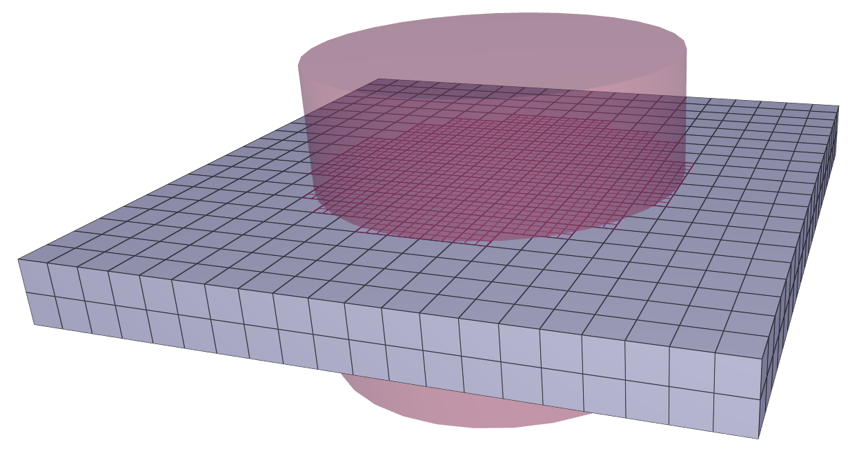
*COMPONENT_BOX 1, 1, 20, 20, 2 0, 0, 0.45, 1, 1, 0.55 *PART 1, 1 *MAT_RIGID 1, 7800 *CHANGE_P-ORDER P, 1, 3, 123 *GEOMETRY_PIPE 123 0.5, 0.5, 0.25, 0.5, 0.5, 0.75, 0.3
Converting polynomial order of elements inside a cylinder (geometry 123)
Linear vs. cubic elements

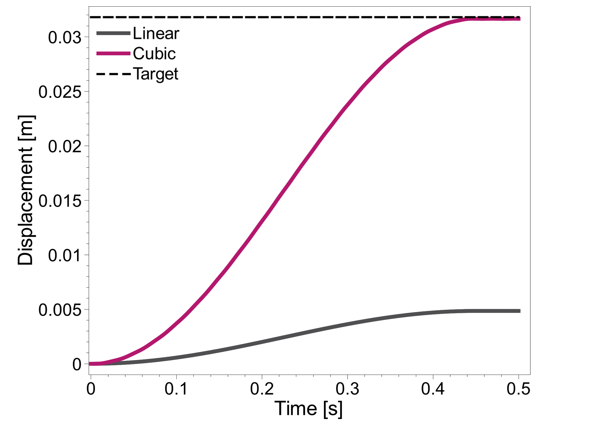
Two cantilever beams are subjected to a transverse point load at the unconstrained end. One of the beams is modeled with five LHEX (Linear hexagonal) elements and the other with five CHEX (Cubic hexagonal) elements. From Euler-Bernoulli beam theory, the maximum deflection, $\mathbf\delta_{max}$ is:

$\mathbf\delta_{max} = \displaystyle{ \frac{PL^3}{3EI} } = \displaystyle{ \frac{1.0e4 \cdot 1.0^3}{3 \cdot 200e9 \cdot \frac{0.05 \cdot 0.05^3}{12}} = 32 mm}$

where, $P$ is the applied load, $L$ is the length of the beam, $E$ is the elastic modulus and $I$ is the moment of inertia. The higher order elements are superior to the linear elements for this model setup.
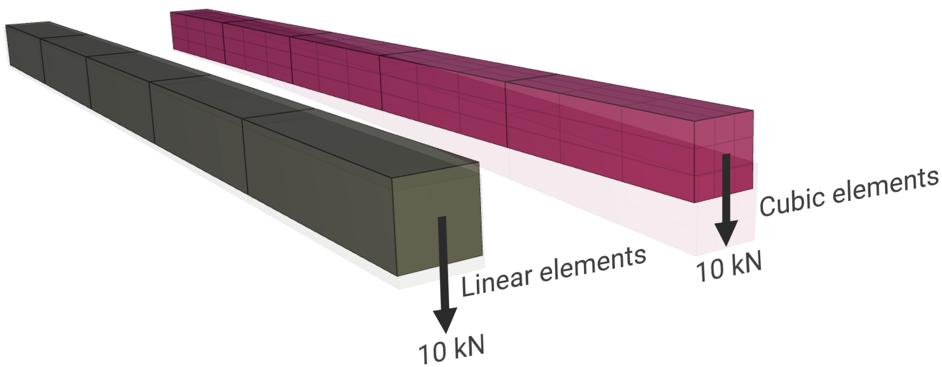
*PARAMETER %tend = 0.5, "Termination time" %l = 1.0, "Length of the beam" %t = 0.05, "Thickness of the beam" %d = 0.1, "Distance value" %F_max = 1e4, "Load applied" *TIME [%tend] *OUTPUT [%tend/5] *UNIT_SYSTEM SI *COMPONENT_BOX "Linear elements" 1, 1, 5, 1, 1 0, 0, [-%d], [%l], [%t], [%t - %d] *COMPONENT_BOX "Cubic elements" 2, 2, 5, 1, 1 0, 0, [%d], [%l], [%t], [%t + %d] *MAT_ELASTIC 1, 7800, 200e9, 0.3 *CHANGE_P-ORDER P, 2, 3 *PART 1, 1 2, 1 #Fixed ends *BC_MOTION 1 G, 1, XYZ *GEOMETRY_SEED_COORDINATE 1 0, [%t/2], [%t/2 - %d] *BC_MOTION 2 G, 2, XYZ *GEOMETRY_SEED_COORDINATE 2 0, [%t/2], [%t/2 + %d] # Prescribed force *LOAD_FORCE 11 G, 11, Y, 10 *GEOMETRY_SEED_COORDINATE 11 [%l], [%t/2], [%t/2 - %d] *LOAD_FORCE 12 G, 12, Y, 10 *GEOMETRY_SEED_COORDINATE 12 [%l], [%t/2], [%t/2 + %d] *FUNCTION 10 smooth_d(%F_max, 0, 0.9*%tend) *OUTPUT_SENSOR "Linear" 1, 1, [%l], [%t/2], [%t/2 - %d] *OUTPUT_SENSOR "Cubic" 2, 2, [%l], [%t/2], [%t/2 + %d] *CURVE "Target" 10000 [0.0*%tend], 0.032 [1.0*%tend], 0.032 *END